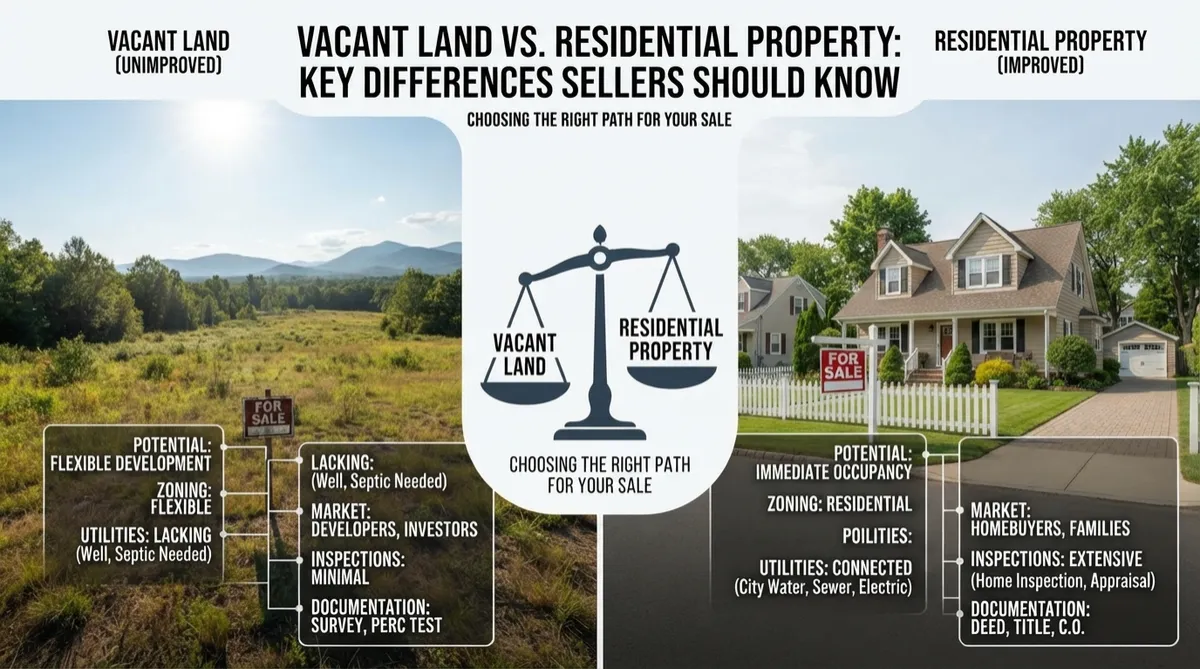
Vacant Land vs. Residential Property: Key Differences Sellers Should Know
Selling real estate is not the same for every type of property. A vacant parcel of land and a home may both be considered real estate, but the way buyers evaluate them can be very different.
Residential property typically has a structure, established utilities, defined living spaces, and a more familiar set of features for buyers to compare. Vacant land requires buyers to think more about what the property could become and what may be required to use or develop it.
Understanding these differences can help landowners set realistic expectations and prepare for a sale.
Vacant Land Has No House to Evaluate
When someone purchases a home, they can evaluate the building itself, including its size, condition, layout, features, and improvements.
With vacant land, there may be no structure to provide an immediate reference point. Buyers instead focus on acreage, topography, access, zoning, utilities, surrounding development, environmental factors, and possible uses.
Buyers May Be Purchasing Potential
A home is generally purchased for its existing use as a residence or investment property. Vacant land can be purchased for many different reasons.
A buyer may want to build a home, hold the property as an investment, use it for recreation, combine it with another parcel, or pursue another permitted use.
Because buyers may be purchasing future potential rather than an existing finished product, information about zoning, access, and development possibilities can be especially important.
Zoning Can Play a Larger Role
Zoning is important for both homes and land, but it can be particularly significant when selling vacant property.
A vacant parcel may have no existing structure demonstrating how it can be used. Buyers may therefore want to know what uses are permitted and whether their intended plans are compatible with local requirements.
Landowners should avoid assuming that a parcel can be used for a particular purpose simply because nearby properties are being used that way. Buyers may conduct their own due diligence, and sellers should provide accurate information.
Access Is Especially Important for Vacant Land
A home usually has an established means of access. With vacant land, buyers may need to investigate how the parcel is reached and whether access is legally and practically available.
Road frontage, easements, rights-of-way, private roads, and physical access can all be relevant.
If access is unclear, buyers may have additional questions before moving forward. Having available information about access can make the property easier to evaluate.
Utilities May Need More Investigation
A residential property often already has connections to services such as electricity, water, sewer, or natural gas.
Vacant land may have no utility connections at all. Depending on the property and intended use, a buyer may need to determine whether services are available nearby and what it would take to connect them.
The availability and cost of utilities can influence how a buyer evaluates the property's potential.
Comparable Sales Can Be Different
Residential properties are often compared using sales of homes with similar characteristics, such as size, location, age, condition, and features.
Vacant land can be more difficult to compare because parcels can differ substantially in acreage, zoning, access, topography, development potential, and other characteristics.
Simply looking at the price of a nearby house may therefore not provide a meaningful indication of what a vacant parcel is worth.
Vacant Land May Have a Different Buyer Pool
The people interested in a home and the people interested in vacant land are not always the same.
Potential land buyers can include individuals, builders, developers, investors, recreational users, neighboring property owners, and others depending on the parcel.
Understanding who may realistically be interested in the property can help a seller think about how the land should be presented and marketed.
Preparation for Sale Can Be Different
Selling a home may involve cleaning, repairs, staging, inspections, and other preparation intended to make the property attractive to residential buyers.
Vacant land generally does not require the same type of preparation. In some cases, extensive clearing or improvements may not be necessary, particularly if buyers are comfortable purchasing the property as-is.
Useful preparation may instead involve gathering accurate property information, confirming known details, organizing documents, and making it easy for potential buyers to understand the parcel.
The Sales Process May Involve More Due Diligence
Because vacant land does not come with an existing building that demonstrates its use, buyers may spend more time investigating certain characteristics.
They may want to verify zoning, access, boundaries, utilities, environmental conditions, taxes, restrictions, and other factors.
The exact process varies by property and buyer. Sellers can help by being transparent about what they know and by allowing the buyer to complete appropriate due diligence.
Price Is Still Important—but It Is Not the Only Factor
As with any real estate transaction, price matters. But buyers also consider whether a property fits their plans.
A parcel with an attractive price may still receive limited interest if it has access, zoning, utility, or other characteristics that do not work for the intended buyer.
Understanding the complete property can therefore be more useful than focusing only on price per acre.
PLC Property Group Insight
At PLC Property Group, we specialize in vacant land, so we understand that selling land requires a different approach from selling a house.
If you're unsure how to prepare your property, what information a buyer may want, or whether selling your land makes sense for your situation, we can discuss the property with you.
Our goal is to make the process straightforward and help landowners understand their options before deciding how they want to proceed.
Key Takeaways
• Vacant land and residential property are evaluated differently.
• Land buyers often focus on potential use rather than an existing structure.
• Zoning and permitted uses can be especially important for vacant parcels.
• Legal and physical access should be understood before selling.
• Utility availability may require additional investigation.
• Land comparable can be more complicated than residential comparable.
• Vacant land may attract a different buyer pool.
• Extensive physical improvements are not always necessary before selling.
• Accurate property information can help buyers evaluate the land more efficiently.
Frequently Asked Questions
Is selling vacant land harder than selling a house?
Not necessarily, but the process is different. Vacant land buyers may conduct different types of due diligence and may have more questions about potential use, access, zoning, and utilities.
Do I need to build something on vacant land before selling it?
No. Vacant land can be sold without developing it. Whether improvements make financial sense depends on the property and the intended buyer market.
Why is zoning so important when selling land?
Zoning helps establish what types of uses may be permitted. Buyers often need this information to determine whether the property fits their plans.
Should I clear my land before selling it?
Not necessarily. Some buyers prefer to purchase land in its existing condition. Before spending money on clearing or other improvements, consider whether the expense is likely to improve the property's marketability enough to justify the cost.
Can PLC Property Group buy vacant land instead of me listing it?
PLC Property Group purchases vacant land and evaluates properties individually. If you are considering selling, you can contact us to discuss your property and learn about your options.
Selling Land Requires a Different Perspective
Vacant land may not have the familiar features of a residential property, but that does not make it less valuable or less marketable. It simply means buyers evaluate it differently.
By understanding zoning, access, utilities, potential uses, buyer expectations, and the type of information buyers need, you can approach the sale with more realistic expectations.
If you're considering selling your vacant land, PLC Property Group can discuss the property with you and help you understand the process. Contact us to start the conversation.